Yes, you can homeschool and work from home. But you probably can’t do it the way you are picturing, with a tidy school room, a nine-to-three lesson plan and a full workday wrapped around it. The families who make it work drop the classroom model first, then build the workday out of the hours that are actually left.
I started homeschooling in 2020, the same year everyone else got sent home, and I run a podcast for exactly this crowd: Women Who Work From Home. Here is what I have learned doing it, and what two of my guests said that I wish someone had told me sooner.
Stop trying to bring school home
This was my first mistake, and I think it is almost everybody’s. On an episode of the podcast I put it like this:
“When I first started homeschooling, was like 2020… I really tried to bring school home. I was trying to do everything that like teachers were in the classroom.”
— Michelle Rivera, Women Who Work From Home
A classroom teacher is managing twenty-five kids. You are not. Most of the hours in a school day exist because of the twenty-five, so when you copy the schedule you copy the waiting, the transitions and the review that your two kids don’t need. Then you try to work in what’s left and there is nothing left.
What changed it for us was simple. If they get it, we move on:
“if we’re in a workbook and we’re working on something and my kids get that concept and I know they get that concept, we’re moving on.”
— Michelle Rivera
We got through curriculum faster, and the kids’ attitudes got better, which made mine better. The workbook says to review it three more times? Not if she already has it.
Same with the space. I have scrolled past plenty of beautiful homeschool rooms. My kids, as I told Kelly Schuknecht on the show, “are such kitchen table homeschool kids… they’d be like, let’s get this done.” You do not need a room. You need a table and a plan.
Be honest that working from home is still work
Kelly has worked from home for 18 years and raised three kids doing it. Her warning is the one people skip:
“working from home isn’t just the ability to be home with your kids and like not really work. Like you have to find ways to make it work for you.”
— Kelly Schuknecht, on Women Who Work From Home
She also said the part we all learn the hard way: “it’s really hard to have a toddler running around the house and also try to be productive and think during the day.” If you have little ones, the work that needs your brain can’t go in the hours when they need you. Email and admin can. Deep work can’t.
Build your day out of blocks, not a nine-to-five
When her kids were small, Kelly’s schedule was what she called “very choppy”: a little email over breakfast, a workout while the gym daycare had them, an hour of work after, nap time, then seven to eleven at night. It worked, though she is honest that it was “not the healthiest mentally for moms.”
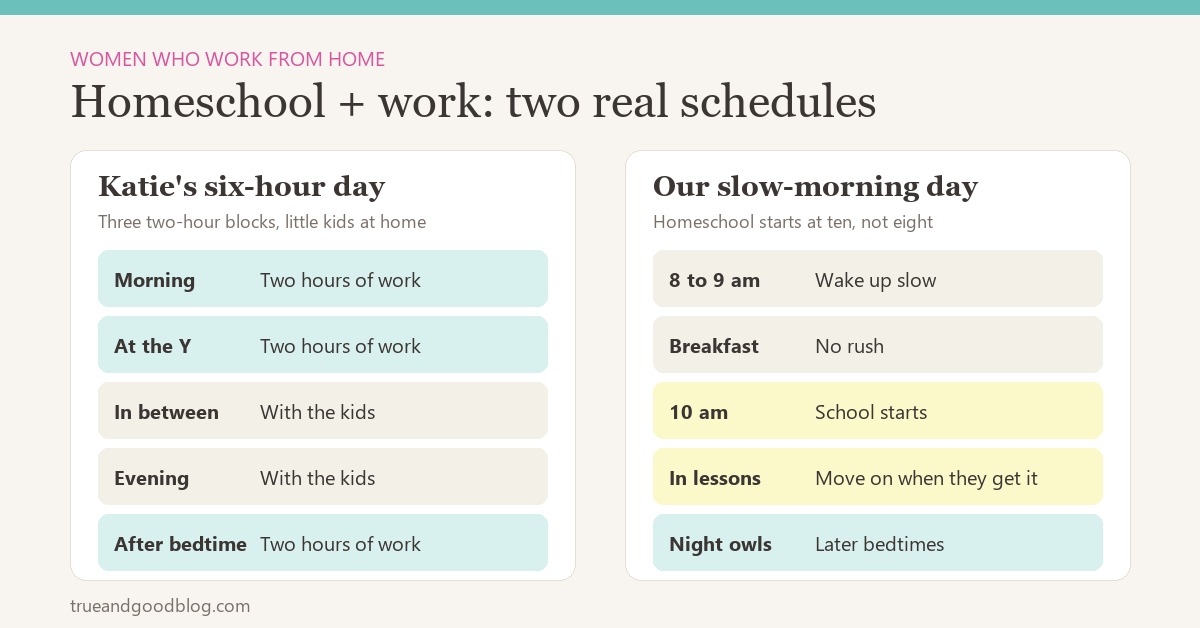
A friend of mine did the same thing on purpose. I remember Katie telling me, “I have two hours in the morning, I have two hours while they’re at the Y, and I have two hours after they go to bed. And that was just my season.” That is a six-hour workday, and nobody in it is being ignored.
Our family runs on the opposite rhythm. We are slow in the mornings and later at night:
“we’re like ready to work by like 11, like 10 at the earliest. I’m constantly saying like thank god we homeschool… because this is just how our schedules are.”
— Michelle Rivera
Neither one is right. The point is that homeschooling lets you choose the rhythm that fits your family, and that is the thing a traditional school day takes away. If you are weighing a split schedule instead, my post on why hybrid work is harder than either option is worth a read first.
Block the days with no school too
Kelly’s tip here is small and it saved me. When her kids had a day off, she started putting it on her calendar “so that I remember there is no school that day and don’t plan meetings.” For homeschoolers, swap that for co-op days, field trips and the week everybody gets sick. If it isn’t on the calendar, a client call will land on top of it.
Say no to more activities than feels comfortable
This is the one I am still working on. It’s really easy as a homeschool mom to think, as I said on the podcast, “I don’t want my kids to miss out on that. Like what kind of parent would I be if I let my kids miss out on that?”
Then you add it up. “It is so many hours of carpooling, volunteering, not to mention like the money you spend on stuff.” Kids do need people, and ours do go places. But every co-op class and troop meeting is also an hour you are not working and an hour you are not resting. Pick the ones that matter for socialisation and let the rest go.
Hand off the house, and let it be done differently
Delegating at home matters as much as delegating at work, and the hard part isn’t asking. It’s letting go of how it gets done:
“Does my husband fill the dishwasher the way I want him to? No. The answer is no… However, do my dishes end up clean? Mostly yes. So I have to be okay with that.”
— Michelle Rivera
Same with chores for the kids. If you re-vacuum the room they just vacuumed, you have taught them it doesn’t count and you have lost the time anyway. I also lean on AI for planning, both the homeschool schedule and the podcast schedule, which takes a surprising amount of mental load off.
You are not the only one doing this
It can feel like a niche choice. It is less niche than it was. The U.S. Census Bureau found that about 5.4% of households with school-aged children reported homeschooling in spring 2020, and 11.1% by fall 2020. That was a pandemic spike, so don’t read it as today’s number. And when the National Center for Education Statistics asked homeschooling parents why, 75% chose “emphasis on family life together” as one of their reasons in 2019.
That is the same reason most of us wanted to work from home in the first place.
So, can you do both? If you are willing to let go of the classroom, the nine-to-five and the perfectly loaded dishwasher, yes. Start with one change this week. Drop one review lesson they don’t need, or block next week’s co-op day on your work calendar, and see what that hour turns into.
Quotes are verbatim from the raw recordings of Women Who Work From Home, trimmed only for false starts. For more on finding the balance, read Jo of the Balance Institute on work, motherhood and burnout.