When offices started reopening, hybrid was sold to all of us as the sensible middle. Two or three days in, the rest at home. The best of both worlds. If you have been living it for a while and quietly wondering why it feels harder than either full-time option ever did — you are not imagining that, and you are definitely not the only one.
I came across a conversation on the Unscripted Small Business Podcast with Jessica Malnik, who runs The Remote Work Tribe and has spent about six years helping founders and team leaders run better remote and hybrid teams. She was asked for her hot take on the worst play companies are running right now, and her answer was not what I expected.
Why Hybrid Feels Worse Than Both
“I would actually argue hybrid work is even harder than in-person in office or fully remote, because you’re basically combining all of the hard parts of in office and all of the hard parts of remote into one thing.”
— Jessica Malnik, The Remote Work Tribe
That reframe was a relief to read, honestly. So much hybrid advice assumes the model is fine and you are the problem — that you just need a better morning routine or a nicer planner. Jessica is saying something different: the structure itself is carrying two sets of costs at once.
And she named the specific thing that goes wrong. You end up, in her words, with “basically a company of second class citizens, where you have the people who are predominantly remote and you have people in the office all the time, and suddenly the ones who are remote don’t even feel included.” If you have ever dialled into a meeting where six people are laughing in a conference room and you are a small square on a screen, you already know exactly what she means. The decision does not get made in the meeting. It gets made in the hallway afterwards.
The Meeting Problem Nobody Fixes
I want to be fair to Jessica here, because she did not offer a tidy solution to this one. Asked about heavy meeting culture, she was frank that it comes with the territory — you would not be in corporate America or even startup America without it — and said plainly that she does not know how to tackle it beyond one thing that helps.
That one thing is writing more down. The companies she sees handling it best skew heavier toward what she calls async first: everything documented, agendas for every meeting, and any decision that gets made recorded somewhere the whole team can see it. Even organisations with a heavy meeting culture do noticeably better when they do that.
For those of us on the receiving end rather than the ones setting policy, that is still useful. If a decision that affects your work was made on an in-office day, the written record is the only thing standing between you and finding out three weeks later. It is entirely reasonable to ask for notes.
Setting Boundaries When Your Days Differ
Here is the part of hybrid that I think gets underestimated: your boundaries have to change shape twice a week. A fully remote schedule lets you build one routine and defend it. Hybrid asks you to run two different lives on alternating days and somehow keep the same standards in both.
A few things that seem to genuinely help:
- Decide what each kind of day is for. Office days are for the things that are better in a room — the meetings, the messy conversations, the catch-ups. Home days are for the deep, uninterrupted work. If you let both days become all meetings, you have taken the worst half of each.
- Put the commute in the calendar. Not just the travel — the getting ready, the parking, the walk in. On office days that time is real and it has to come from somewhere.
- Protect the buffers. When I talked with Kelly Schuknecht, who has been working from home for 18 years, this was one of her hardest-won lessons: an open calendar is not the same as an available one. As she put it, you also have to factor in the times when “I need a break between back-to-back meetings or I need time to get to this thing or that thing.”
- Pick an end time and mean it. The day you worked from home is the day it is easiest to keep drifting back to the laptop after dinner.
Making A Home Office Work Three Days A Week
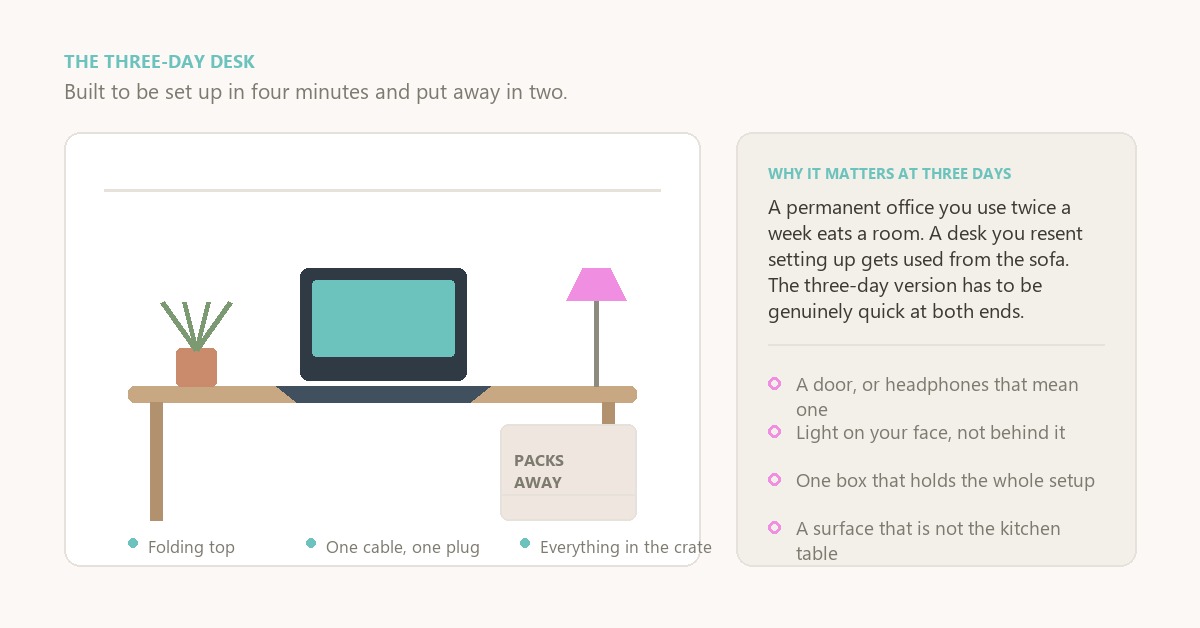
This is where hybrid gets genuinely awkward at home. A full-time remote worker can justify giving over a whole room. At three days a week — or two — that is a harder case to make, especially if the space is doing something else the rest of the time.
The setup that seems to survive is the one built to be quick at both ends. Something you can put together in a few minutes and pack away in less, because a desk you resent setting up is a desk you will abandon for the sofa by Wednesday. A surface that is not the kitchen table. Light on your face rather than behind you, which matters more than anything else you will buy. One box or basket that holds the whole kit, so “putting work away” is a single action. And a door — or headphones that everyone in the house has agreed count as one.
Small spaces make this a design problem more than a budget problem. If you are working out what actually fits, I put together a list of the best places to find stylish small-space furniture that is worth a look before you buy anything full-sized.
What To Ask Your Employer For
Most of us treat the hybrid schedule as weather — something that happens to us. It is worth remembering that a lot of it is still being figured out, and reasonable requests often land better than you would expect. A few that are worth making:
- Predictable days, set in advance. Floating office days make it impossible to plan childcare, appointments or anything else.
- A written record of decisions. Notes, a summary, a channel — whatever form it takes, so the in-office conversation does not become the only version of events.
- Meetings that are actually hybrid. If even one person is remote, everyone joins from their own screen, or the room uses a setup where the remote people can genuinely hear and be heard.
- A contribution toward the home setup. If the company is saving on desk space three days a week, a chair or a monitor is not an outrageous ask.
- Clarity on what office days are for. If nobody can answer that, it is fair to ask.
Hybrid is probably not going anywhere, and for a lot of families it is still the arrangement that makes everything else possible. But it is not the easy middle option it was sold as, and I think there is real value in naming that out loud. If it has felt harder, that is because it is.
More on working from home, and making a home work while you are in it, over on the blog.